 30b4d7946c Three pieces so the surfaces built earlier can actually be judged. The `instance-awareness` skill teaches the ladder rather than the tools: ask about intent, look up state; read cheapest-first and stop at the first rung that answers the question; treat an absence in the node-usage histogram as evidence rather than as a gap. It also says where each surface stops — the log records that a save happened and the node count changed, never which nodes, so anything about contents is a workflow read. Four eval cases on a new `activity` tier, which also carries `memory` so they run under both. Two are authored from real reviewed traces rather than invented: lang-tracer observation 3870 and its siblings, where the agent restarted work it had just finished and re-elicited requirements it already had. Their A/B discriminator is a probe-anchored context assertion — with the feed off nothing carries the prior workflow into the turn, so it can only arrive via a tool call, which is turn-end and not probe. That distinction is the measurement. Every case is scored on behaviour, never on narration. A probe that asks the agent to describe its own context manufactures its own evidence, which is the restatement confound recorded on this branch. So the checks ask whether it re-elicited a known requirement, whether it named the broken workflow, whether it picked the house node — not whether it can recite the block. The fourth case is the negative control, and the one that should stop a rollout: loud recent activity plus an unrelated request. It deliberately does not assert that the recent workflow is absent from context — it will be there, the feed put it there. What is scored is whether the agent acted on it. Having a fact and using it are different, and that difference is the whole point. scripts/ab-activity-eval.sh drives both arms. They differ by a flag on the instance under test, not by a runner argument, so each arm needs its own start — the flag is read once when the relay registers. The script says what to read and in what order, with context-ignored first. Also opens the activity preamble up. It forbade narrating the feed but never granted permission to act on it, which left the agent with a list of work it was implicitly told to ignore. It now says this is work you can pick up, that a vague opener usually means the most recent thing, and points at the skill. Two honest limits recorded in the README. `node-usage` is not gated by the flag, so the preference case measures a capability both arms have and a difference there is noise. And that case has no historical precedent: a sweep of 16,262 traces found no conversation where a user stated a node preference their own workflows already showed. |
||
|---|---|---|
| .agents/skills | ||
| .claude | ||
| .devcontainer | ||
| .github | ||
| .opencode/skills/setup-mcps | ||
| .vscode | ||
| assets | ||
| docker | ||
| docs | ||
| packages | ||
| patches | ||
| scripts | ||
| security | ||
| .actrc | ||
| .aikido | ||
| .boundaries-baseline.json | ||
| .code-health-baseline.json | ||
| .dockerignore | ||
| .editorconfig | ||
| .env.eval.example | ||
| .env.local.example | ||
| .git-blame-ignore-revs | ||
| .gitattributes | ||
| .gitignore | ||
| .npmignore | ||
| .npmrc | ||
| .poutine.yml | ||
| .prettierignore | ||
| .prettierrc.js | ||
| .tbls.postgres.yml | ||
| .tbls.sqlite.yml | ||
| AGENTS.md | ||
| biome.jsonc | ||
| CHANGELOG.md | ||
| CLAUDE.md | ||
| CODE_OF_CONDUCT.md | ||
| codecov.yml | ||
| CONTRIBUTING.md | ||
| CONTRIBUTOR_LICENSE_AGREEMENT.md | ||
| cubic.yaml | ||
| lefthook.yml | ||
| LICENSE_EE.md | ||
| LICENSE.md | ||
| package.json | ||
| pnpm-lock.yaml | ||
| pnpm-workspace.yaml | ||
| README.md | ||
| SECURITY.md | ||
| tsconfig.configs.json | ||
| tsconfig.json | ||
| turbo.json | ||
| vitest.workspace.ts | ||
n8n – The Platform for AI Agents and Workflow Automation
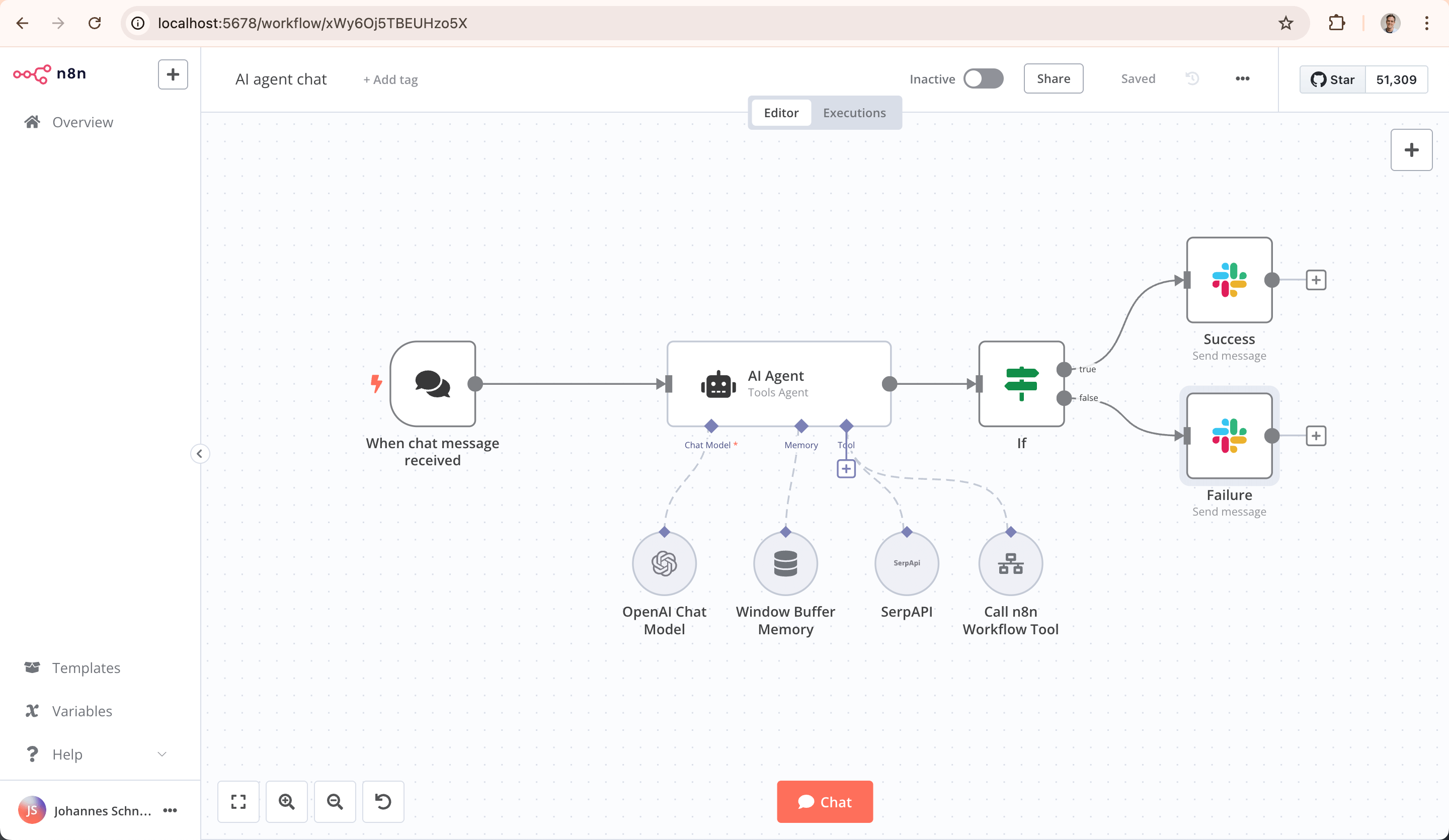
Fair-code platform to build and deploy AI agents and workflows. Combine a visual canvas with custom code, run it self-hosted or in the cloud, and connect to 1500+ integrations. AI automation you can trust with real work, from prototype to production.
Key Capabilities
- AI-Native Automation Platform: Build and operationalize AI workflows and multi-step agents using your own data, models, and tools
- Model Flexibility, No Lock-In: Connect to OpenAI, Anthropic, Google, or open-source models and switch providers without changing your architecture
- From Prototype to Production: Design multi-step AI workflows with logic, tool use, human approvals, and full observability
- Code When You Need It: Combine visual building with JavaScript, Python, and npm packages for advanced AI workflows
- Enterprise-Ready AI: Self-host or deploy securely with role-based access, audit trails, and support for sensitive data
- Leverage What Already Exists: 1500+ integrations and 9,000+ workflow templates to connect AI with your existing systems
Quick Start
Try n8n instantly with npx (requires Node.js):
npx n8n
Or deploy with Docker:
docker volume create n8n_data
docker run -it --rm --name n8n -p 5678:5678 -v n8n_data:/home/node/.n8n docker.n8n.io/n8nio/n8n
Access the editor at http://localhost:5678
Resources
- 📚 Documentation
- 🔧 1500+ Integrations
- 💡 Example Workflows
- 🤖 AI & LangChain Guide
- 👥 Community Forum
- 📖 Community Tutorials
Support
Need help? Our community forum is the place to get support and connect with other users: community.n8n.io
License
n8n is fair-code distributed under the Sustainable Use License and n8n Enterprise License.
- Source Available: Always visible source code
- Self-Hostable: Deploy anywhere
- Extensible: Add your own nodes and functionality
Enterprise Licenses available for additional features and support.
Additional information about the license model can be found in the docs.
Contributing
Found a bug 🐛 or have a feature idea ✨? Check our Contributing Guide for a setup guide & best practices.
Join the Team
Want to shape the future of automation? Check out our job posts and join our team!
What does n8n mean?
Short answer: It means "nodemation" and is pronounced as n-eight-n.
Long answer: "I get that question quite often (more often than I expected) so I decided it is probably best to answer it here. While looking for a good name for the project with a free domain I realized very quickly that all the good ones I could think of were already taken. So, in the end, I chose nodemation. 'node-' in the sense that it uses a Node-View and that it uses Node.js and '-mation' for 'automation' which is what the project is supposed to help with. However, I did not like how long the name was and I could not imagine writing something that long every time in the CLI. That is when I then ended up on 'n8n'." - Jan Oberhauser, Founder and CEO, n8n.io